Volume 60, Issue 3
The Magazine of The Concrete Society, April, 2026
Author: Andy Vincent
SCREEDS – IS THERE MORE TO THEM THAN YOU THINK?
Screeds are very simple things. They sit on the structural slab to provide the flat, level surface that floor finishes need and that the structure can rarely provide. Andy Vincent of Cemfloor says that their varied benefits are only just beginning to be realised.
Introduction
Screeds are not structural elements, so little thought has ever gone into their design. We simply know from British Standards what thickness they need to be for any particular building type and historically, we used simple mixes of sand and cement with a very manual-intensive method of installation.
Very often, screeds were mixed with shovels by the same team, who would then compact the material onto the floor and ensure it was flat and level. In fact, the installation of a ‘traditional’ screed is a very skilful occupation when done properly, but we still tend to think of screeds as a basic element.
Over 30 years ago in the UK, we began using liquid-applied, flowing screeds. These initially received a fairly poor reception, but they gradually gained traction in the marketplace. Real growth began approximately eight years ago and since then, sales of liquid screeds have tripled, accounting for close to 50% of the screed market, with every indication that this growth will continue.
Perception
Despite the recent success of liquid materials, which offer many advantages over traditional sand–cement screeds, screeds are still largely seen as a basic necessity. They are often considered unimportant as long as they lie flat and do not cause any problems.
However, there are now signs that at least some of the benefits of considering screeds more carefully are beginning to be recognised.
Certainly, the speed benefits of installing liquid screeds have been acknowledged, along with the health and safety improvements, and, perhaps best of all, the potential cost savings that can result from their correct use. These obvious benefits, however, are really just scratching the surface of what can be achieved by giving more thought to how screeds are used.
Underfloor Heating & Efficiency
Underfloor heating use is rapidly growing in the UK, driven by the ambition to create ever more energy-efficient buildings and the stringent regulations that support this.
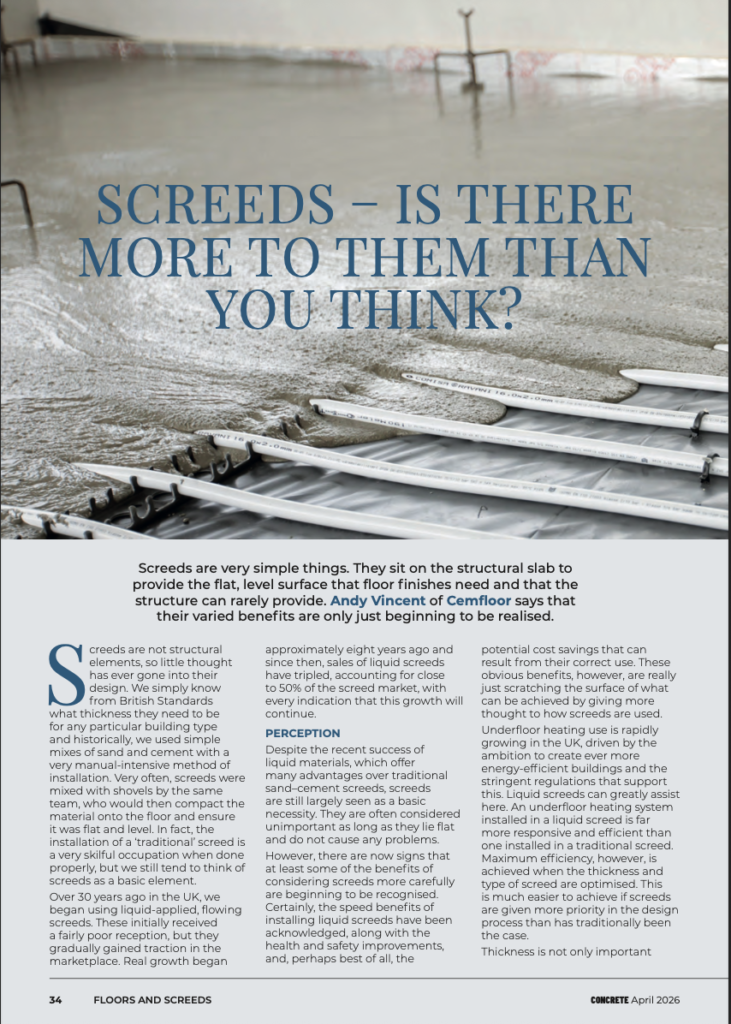
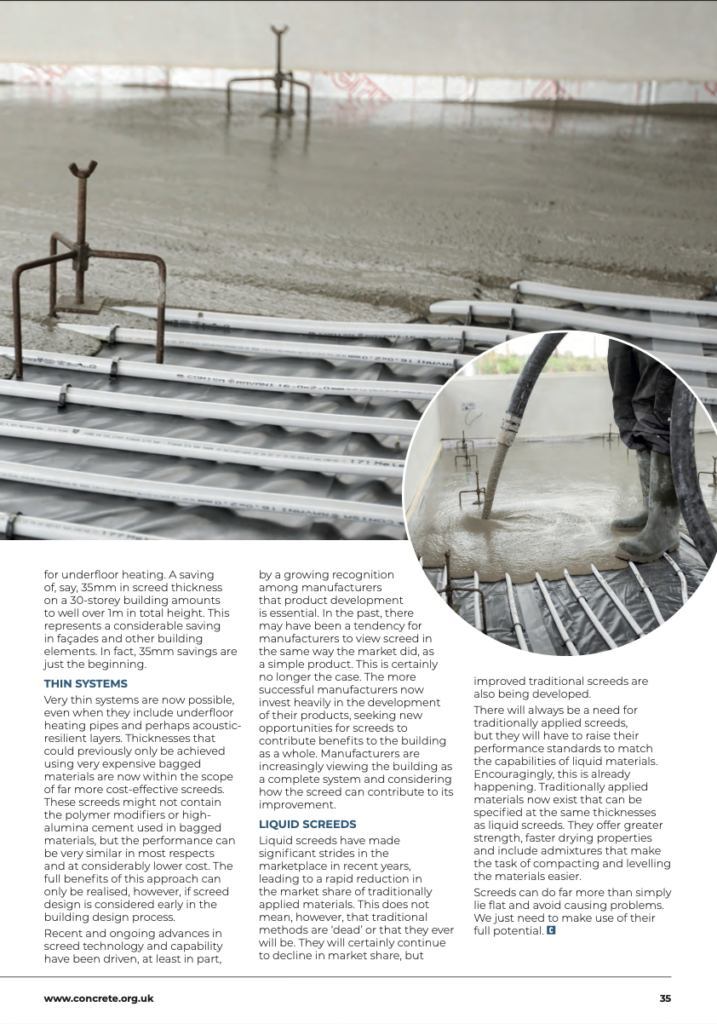
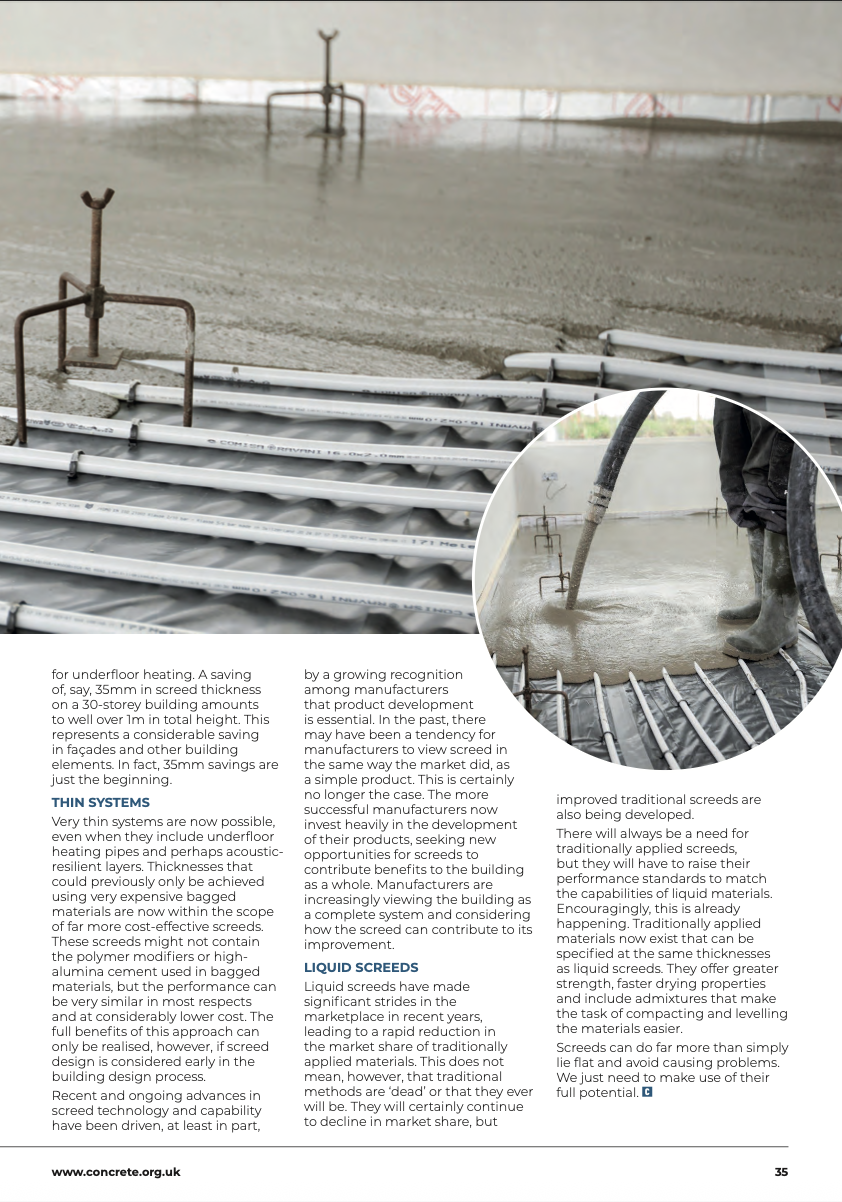
Liquid screeds can greatly assist here. An underfloor heating system installed in a liquid screed is far more responsive and efficient than one installed in a traditional screed.
Maximum efficiency, however, is achieved when the thickness and type of screed are optimised. This is much easier to achieve if screeds are given more priority in the design process than has traditionally been the case.
Thickness & Structural Impact
Thickness is not only important for underfloor heating. A saving of, say, 35mm in screed thickness on a 30-storey building amounts to well over 1m in total height.
This represents a considerable saving in façades and other building elements. In fact, 35mm savings are just the beginning.
Thin Systems
Very thin systems are now possible, even when they include underfloor heating pipes and perhaps acoustic-resilient layers.
Thicknesses that could previously only be achieved using very expensive bagged materials are now within the scope of far more cost-effective screeds.
These screeds might not contain the polymer modifiers or high-alumina cement used in bagged materials, but the performance can be very similar in most respects and at considerably lower cost.
The full benefits of this approach can only be realised, however, if screed design is considered early in the building design process.
Innovation & Development
Recent and ongoing advances in screed technology and capability have been driven, at least in part, by a growing recognition among manufacturers that product development is essential.
In the past, there may have been a tendency for manufacturers to view screed in the same way the market did, as a simple product. This is certainly no longer the case.
The more successful manufacturers now invest heavily in the development of their products, seeking new opportunities for screeds to contribute benefits to the building as a whole.
Manufacturers are increasingly viewing the building as a complete system and considering how the screed can contribute to its improvement.
Liquid Screeds
Liquid screeds have made significant strides in the marketplace in recent years, leading to a rapid reduction in the market share of traditionally applied materials.
This does not mean, however, that traditional methods are ‘dead’ or that they ever will be. They will certainly continue to decline in market share, but improved traditional screeds are also being developed.
There will always be a need for traditionally applied screeds, but they will have to raise their performance standards to match the capabilities of liquid materials.
Encouragingly, this is already happening. Traditionally applied materials now exist that can be specified at the same thicknesses as liquid screeds. They offer greater strength, faster drying properties and include admixtures that make the task of compacting and levelling the materials easier.
Conclusion
Screeds can do far more than simply lie flat and avoid causing problems. We just need to make use of their full potential.